Sunday, 22 May 2016

Representation of Gender in the Media homework: Week 6

As the media industry plays such a significant role in shaping the dominant views of society, it also has a massive responsibility when it comes to the representation of men and women. What could media producers do to create a society where they is more equality (in terms of gender representation)?
Overall, the media can make the effort to better represent women and move on from the stereotypical image that they have created of them. Video games should start to encourage female protagonists and balance the strength that they represent in gender. Magazines should stop encouraging the 'perfect' image of a women and introduce stories about self acceptance and morality. As a whole, important figures in the media should start to use their voice in a positive way that will help to equalise men and women in the media. Actress Jennifer Lawrence is an example of a celebrity using their voice and becoming a spokesperson for change, writing an article about the gender pay gap after Sony's pay cheques for the actors of American Hustle were leaked and it was apparent that she was paid less than her male costars (http://www.lennyletter.com/work/a147/jennifer-lawrence-why-do-i-make-less-than-my-male-costars/). In general, the media should start to equalise men and women and present them as equal so that it will have the correct, positive influence on younger generations.

Representation of Gender in the Media homework: Week 5

Judith Butler (http://www.theory.org.uk/ctr-butl.htm) believes that we are not born into a gender and that gender is different to sex (male/female).   She say that we ‘learn’ how to be a particular gender through adopting characteristics that we ‘learn’ from society (the media included). What evidence (from the media) could be used to suppourt her opinion?
The media can be seen to have a huge influence on gender, and how we 'adapt it', especially within women. Women in the media are often sexualised and presented with the ideal and perfect body images which overall can have a huge impact on young girls who view these images/videos. It can drive young girls to achieve this unrealistic representation of what is normal and acceptable, when often these images are photoshopped or edited. An article about women in the media highlights how we are manipulated to achieve the unimaginable and also how the media has driven "29% of 11-16 year old girls to be "not at all happy with the way they look"". Overall, the media can drive a huge influence in gender, especially young girls and how it 'teaches' them to learn to adapt the female gender from what is shown to them on TV, in magazines and films etc.
http://www.fawcettsociety.org.uk/policy-research/attitudes-media-culture/

Representation of Gender in the Media homework: Week 4

- Define the phrase 'patriarchal society'.
A society ruled by men, in which males are in authority over women in all aspects of society.

- Do you think you live in a patriarchal society?
To some extent, i believe this statement to be true as our lives are heavily influenced by how they are represented in the media in which predominately focuses on gender and how males are the main attention. This divide in gender also affects us somewhat subconsciously by the gender pay gap.
On average, females make less money than males who work the same job and hours going far in showing how males dominate society. This pay gap can result in women making an average of $1.4 million less than men over a lifetime including time off for caring for children and illness. This divide in gender economically can be seen as a clear example of how males are seen as more important and more 'deserving' over females in society.

Representation of Gender in the Media homework: Week 3

Read this (http://www.bustle.com/articles/143690-female-oscar-winners-are-more-likely-to-be-wives-than-anything-else-the-discovery-is) article, which discusses female Oscar-winners - Summarise the key arguments made in this article into 5 bullet points.

  • 16% of women who have won 'Best Actress' over the past 88 years of Academy Awards have done so for playing the role of a wife. In the nominees for 2016 alone, 2 out of the 5 women nominated played the role of wife in their films.
  • In contrast, only 2% of men have won for playing husbands.
  • The fact is, films are often regarded and as idealized version of reality and so often present ideas of the 'ideal' wife/husband in order to make us realise that we are not necessarily the people we see represented on-screen.
  • The numbers also indicate how men and women are allowed to represent themselves on-screen. Six 'Best Actress' Oscars have been awarded to women playing sex workers, while the number of male remains at 0.
  • "The roles recognized by awards shows help perpetuate a system in which women are taught to value their bodies and gender roles as mothers and wives over their minds."

Representation of Gender in the Media homework: Week 2

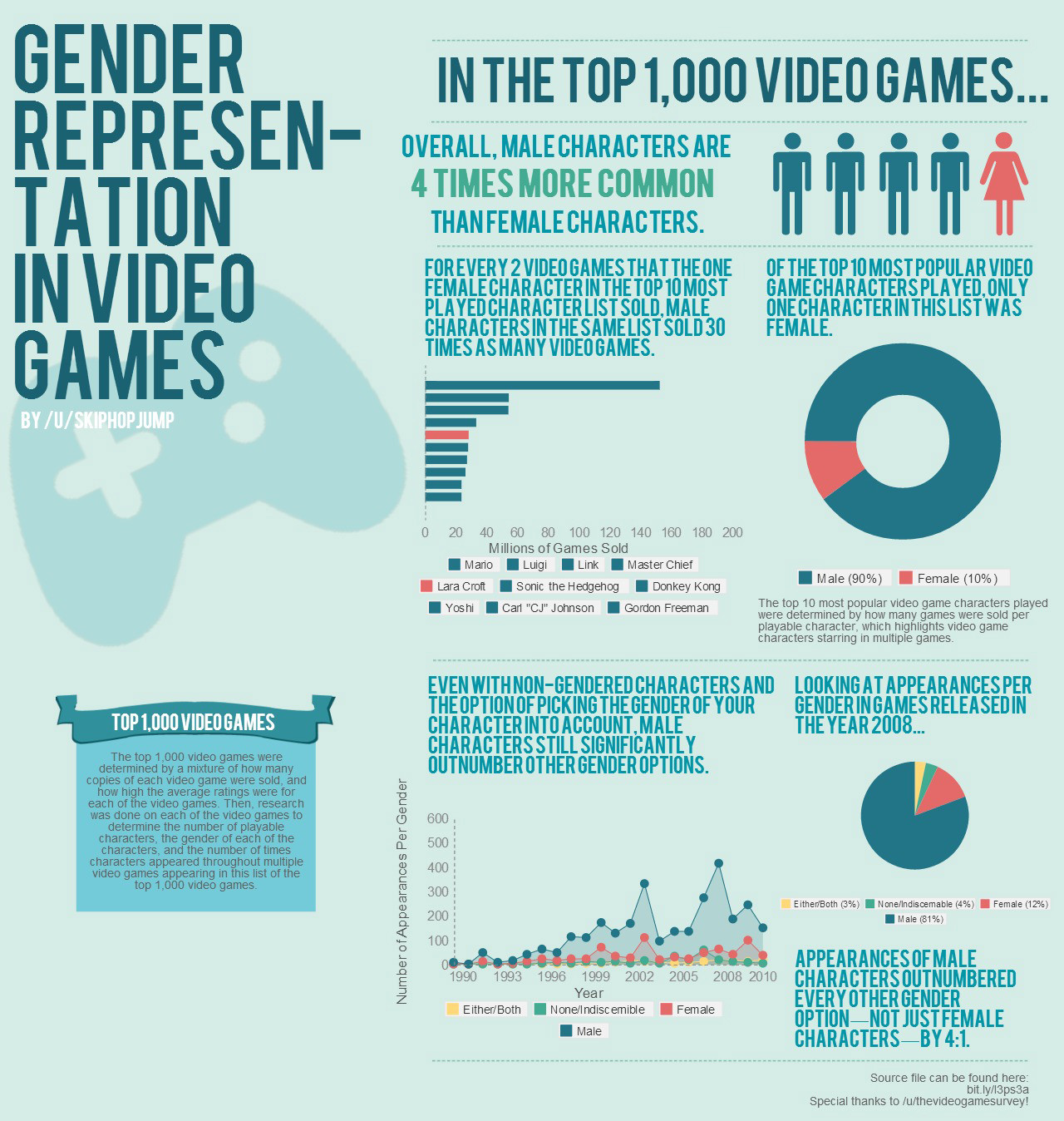
Read this (https://mattdent123.files.wordpress.com/2014/01/xw7ho9q.jpg) infographic, which explores the facts related to female video game characters - What do you think are the main reasons for this lack of equality in representation?
I think the main reason for this divide in gender in video game characters is how we grow up watching TV, films etc. and see male characters being shown to be 'stronger, more adventurous' and better in general than female players. As well as that, the majority of video game players are in fact male and even though this number has grown to be more equal in recent years, it can be seen as a good explanation for this divide due to the fact that males stereotypically choose to play with male characters when given the choice. We can also suggest that this difference is down to the fact that video game characters were originally male and so many game developers have stuck to this structure to be successful and faithful. Overall, it can be seen that this divide is because of how gender is represented in the media and how we are 'taught' that males are powerful and strong, and females are weak and 'pretty' and therefore predominately chose to play with male characters in order to be successful within a game.

Representation of Gender in the Media homework: Week 1

Raynor describes representation as "The process by which the media present the 'real world'" which means that everything in the media is a representation; everything we see is being represented and this is to portray the stereotypical view of the world.

- Do you think that the media (films, newspapers, music videos, TV programmes and magazines etc.) present the real world?
Personally, i do not think that the media represents the 'real world' accurately or realistically as stories/shows are often manipulated to make them appear more interesting and engaging and therefore make more money. The media is also biased and primarily focuses on publishing controversial stories such as those about celebrities, religious stereotypes, politics etc. rather than writing articles about 'real world' events such as medical advances and the positive work of refugees and black people.

Another example of this stereotyping in the media is the gender gap in TV presenters. CML wrote the following article "How do Media images of Men affect our lives?" about how TV is dominated by males and how this difference affects our lives as we watch. It highlights ideas about how the 'perfect, less real man' is broadcasted on our television screens and how we are taught gender roles in society. http://www.medialit.org/reading-room/how-do-media-images-men-affect-our-lives

The following image is taken from an article about how social media is influencing the way in which we view the 'real world' and how they are a false representation.